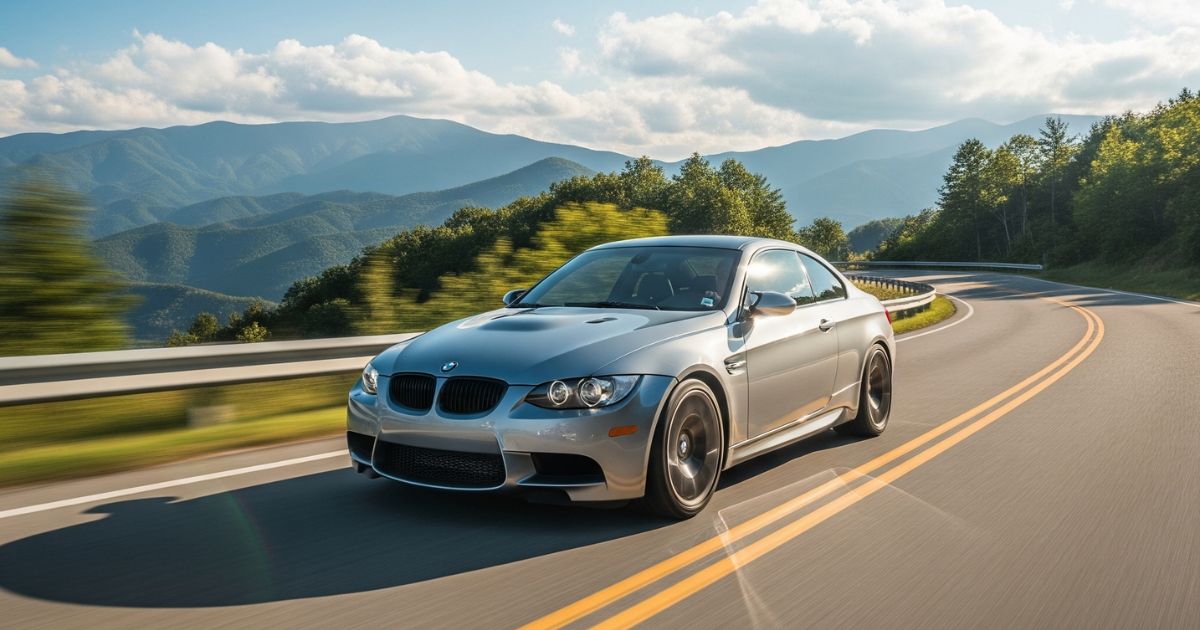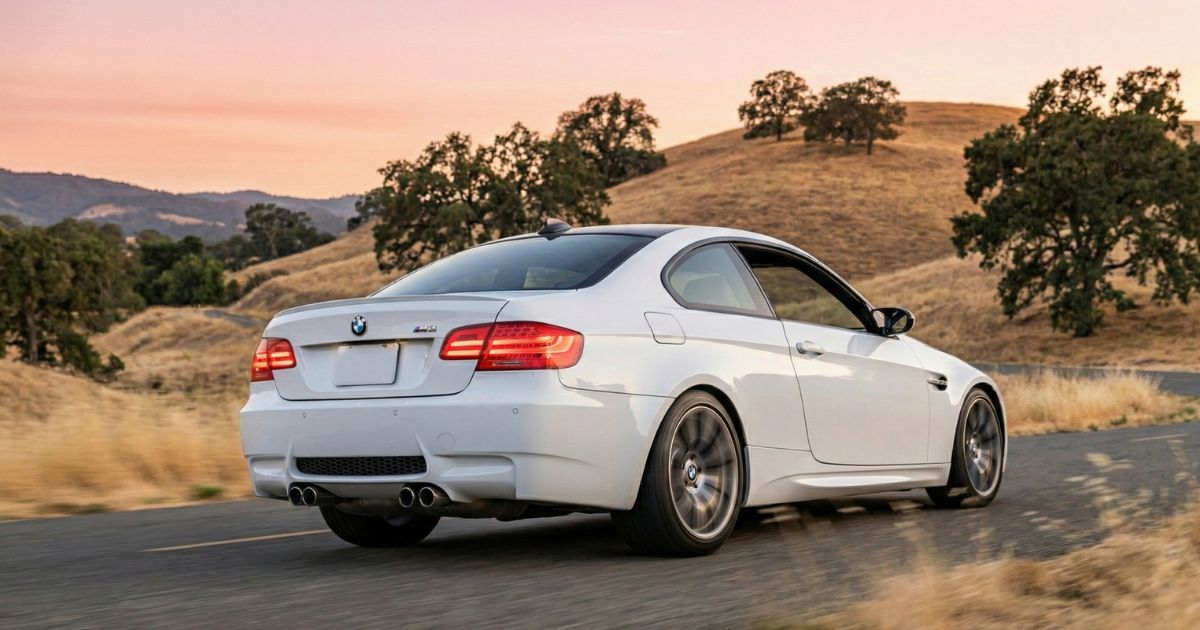
There are cars you drive and cars you experience. The first group serves a purpose. The second stands on its own entirely. The E92 M3 belongs to the second category, and it got there by doing something bold at exactly the wrong moment.
As the industry began its march toward turbocharging and downsizing, BMW's M Division went the other direction. They put a 4.0-liter naturally aspirated V8 in a mid-size sedan and gave it an 8,400 RPM redline. It was a farewell to an idea, a love letter to a kind of engine that the industry was already walking away from. The timing made it more significant, not less.
The S65 V8: More Than an Engine
Open the hood and you are looking at something that rewards attention. The S65 is derived from the V10 in the E60 M5, detuned, yes, but carrying that engine's DNA in its construction and its character. Power builds smoothly and linearly all the way to the redline, without the sudden surge of a turbocharged car or the flatness of an engine that runs out of ideas before it runs out of revs.
What makes it special is not the horsepower number. It is the way that number arrives. Every revolution feels intentional. The tachometer needle moves with a sense of drama that modern turbocharged engines, for all their capability, genuinely cannot replicate. This is an engine that does not just make power, it performs.
What the Road Feels Like
The hydraulic steering is the first thing that earns your trust. It is direct in a way that electric systems approximate but do not match, you feel texture changes, grip variations, the subtle communication between tire and road that tells you what the car is doing before your eyes confirm it. It is a conversation, not a sequence of inputs and responses.
The chassis matches that directness. The car turns in eagerly and holds its balance through corners with a precision that makes you want to push further. You can adjust the car's attitude with the throttle in a way that feels natural rather than dramatic, the E92 M3 rewards a driver who is paying attention rather than one who is simply pointing and accelerating.
The Transmission Choice
The six-speed manual is the purist's choice and it earns that status, the throws are precise, the clutch weight is right, and it connects you to the engine's character in the most direct way possible.
The seven-speed DCT surprises people who dismiss it on principle. In stop-and-go traffic it can feel abrupt. On an open road it is something else, shifts arrive faster than conscious thought, each upshift delivers a physical jolt, each downshift triggers a sound that makes you immediately want to do it again. It is a genuine alternative, not a consolation.
The Sound
The E92 M3 does not make noise. It produces something more structured than that. At idle there is a deep, settled rumble that hints at what is coming. Through the mid-range it builds into something harder-edged and more insistent. As the revs climb toward that 8,400 RPM redline it transforms into a high-pitched wail that connects directly to something emotional rather than rational. You do not just hear it, you feel it.
How It Compares
The Mercedes C63 AMG of the same era overwhelms with displacement and torque. The Audi RS4 offers all-weather security through all-wheel drive. Both are legitimate choices for legitimate reasons.
The E92 M3 is the scalpel in that comparison. Less interested in raw force than in precision, less focused on making you feel safe than on making you feel capable. It does not do the work for you, it shows you how to do the work yourself and makes that process genuinely enjoyable. The result is a car that makes you a more engaged driver rather than a faster passenger.
The Honest Part
The rod bearing concern is real and documented, we cover it in detail in our E9X M3 buyer's guide. Fuel consumption is what it is. Running costs are not modest.
None of that changes what the car is. You do not buy an E92 M3 because it is economical. You buy it because it offers a kind of driving engagement that the industry has largely moved away from, and because every time you drive it you are reminded of exactly why that matters.
The Legacy
The E92 M3 was not the fastest M3 in a straight line. It was the one that taught you how to drive. It marked the end of a specific engineering philosophy, naturally aspirated, high-revving, driver-focused above all else, and it did so with enough conviction that a decade later it is more appreciated, not less.
In a market full of increasingly insulated driving experiences, that legacy is worth something real.
Frequently Asked Questions
How does the E92 M3 driving experience compare to the newer F80 M3?
The F80 is faster, more capable by most measurable standards, and more comfortable in daily use. The E92 is more communicative and more demanding, it asks more of the driver and rewards that engagement more directly. Which is better depends entirely on what you want the car to do for you.
Is the E92 M3 still worth buying as a driver's car in 2026?
Yes, with the important caveat that rod bearing history must be documented or addressed before the car is driven hard. A properly maintained E92 M3 with documented bearing service remains one of the most rewarding driver's cars available at its current price point.
What makes the S65 V8 different from other performance V8s of its era?
The S65 was built around high-RPM performance rather than low-end torque. Its naturally aspirated character, individual throttle bodies, and 8,400 RPM redline give it a linearity and a sound that turbocharged V8s of the same period do not replicate. It is an engine designed to reward drivers who use the full rev range rather than one that does its best work in a narrow band.