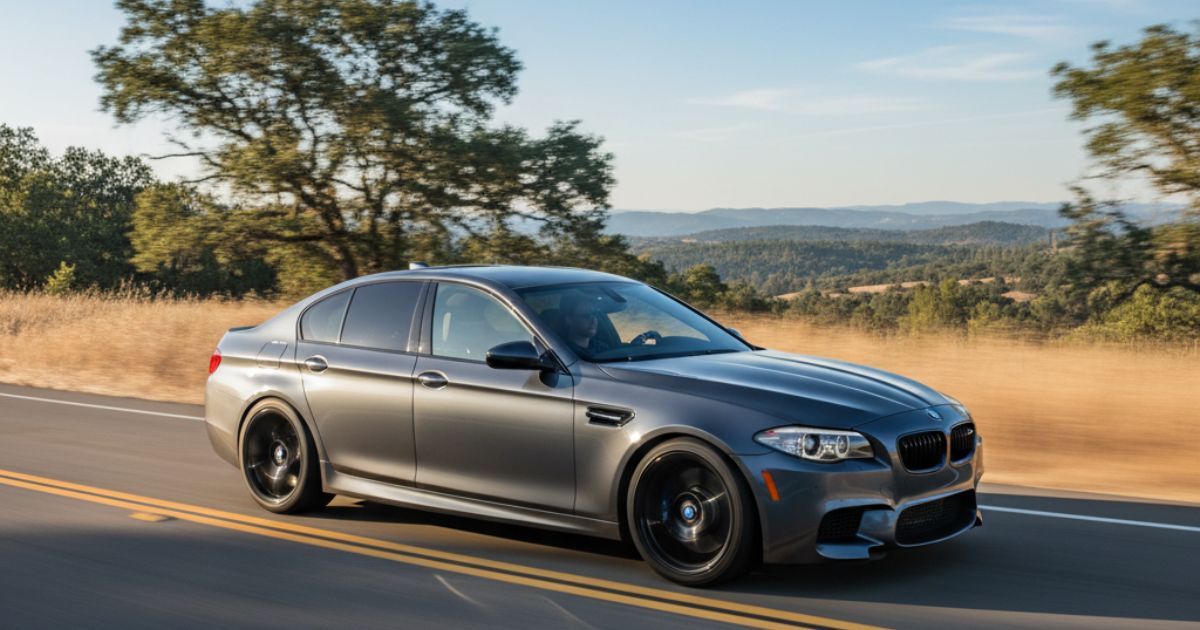
There are few places that expose a car's true character like the winding roads of Northern California's foothills. The pavement twists through the hills in long sweeping curves and tight switchbacks, away from marketing brochures and spec sheets. This is where I took the BMW F10 M5 to find out what it actually is, not what BMW says it is.
The M5 has always been a contradiction. A leather-lined boardroom that carries the heart of a track car. But the F10 generation marked a genuine shift in that lineage. BMW replaced the screaming naturally aspirated V10 of the E60 with a twin-turbocharged V8, and that decision still divides enthusiasts a decade later. After a day behind the wheel, I understand both sides.
What the Canyons Reveal
The F10 M5 is not a back-road dancer. Get it into a tight canyon and its size and weight become impossible to ignore. At 4,387 pounds, the physics are working against you regardless of what the Active M Differential is doing.
The steering is the other honest truth this car tells in the canyons. It is competent, accurate, responsive enough, but it lacks the telepathic connection that defined earlier M cars. There is electronic mediation between your hands and the front tires, and you feel it. The car does what you ask, but it does not always tell you what it is doing. For a driver who came up on E39s and E60s, that distance is real and worth acknowledging.
None of this makes the F10 M5 a bad car. It makes it a different kind of M5, one that requires you to adjust your expectations before you adjust your driving.
The Sound Question
The E60's V10 produced a noise that felt like a motorsport event had broken out under the hood. The S63 twin-turbo V8 in the F10 is a different proposition entirely. It rumbles with authority and makes clear this is not a standard 5 Series, but the theatrical shriek is gone. Inside the cabin the engine note is further insulated, refined to the point where it occasionally feels like the soundtrack has been turned down on purpose.
Whether that bothers you depends entirely on what you want from the car. If the auditory experience was central to why you loved the E60, the F10 will feel like a step back. If you can separate that from everything else the car does, the picture looks different.
Where the F10 M5 Is Genuinely Dominant
The complaints about canyon behavior largely evaporate the moment you reach open highway. This is where the F10 M5 stops being a compromised back-road car and becomes something else entirely, a long-distance powerhouse with almost no equivalent at its price point.
The 4.4-liter S63 V8 produces 560 horsepower and 502 lb-ft of torque available from 1,500 RPM. The acceleration is not dramatic in the theatrical sense, it is simply relentless. It builds and keeps building in a way that does not feel like it is going to run out. The Hot-V turbocharger layout, with the turbos nestled between the cylinder banks rather than outside them, shortens the distance exhaust gases travel and virtually eliminates lag. The throttle response is immediate in a way that turbocharged cars of this era often are not.
Combine that with the M5's genuine grand touring ability, the ride quality, the cabin refinement, the long-distance comfort, and you have a car that covers ground faster and more comfortably than almost anything else you could buy used at this price.
The Honest Verdict
The F10 M5 is not the purest M5 ever made. It gave up back-road agility and the V10's operatic character in exchange for turbocharged torque, grand touring refinement, and a different kind of dominance. That is a real trade-off and it is worth being honest about.
But on its own terms, the F10 M5 is a remarkable machine. It redefined what a super sedan could be in a turbocharged era, and it did so convincingly enough that its used market values have held well as buyers recognize what it offers. This is a car that rewards you for understanding what it is, rather than punishing you for expecting what it is not.
Frequently Asked Questions
Is the BMW F10 M5 reliable for regular driving?
The S63 engine has specific maintenance requirements, oil changes at appropriate intervals, charge pipe inspection on higher-mileage cars, and rod bearing awareness similar to other high-performance BMW V8s. Properly maintained examples are capable daily drivers. The key, as with all M cars, is a documented service history that confirms the maintenance was done correctly and on schedule.
How does the F10 M5 compare to the E60 M5 as a daily driver?
The F10 is significantly more usable day-to-day. The E60's V10 is more emotionally engaging but demands more from its owner, the SMG gearbox, the high-maintenance V10, and the more raw character make it a more committed ownership proposition. The F10 is the more practical choice for a buyer who wants to drive regularly without the E60's operational demands.
What is the ideal use case for an F10 M5?
Long-distance highway driving and open road touring is where this car genuinely excels. It is also a capable canyon car for drivers who adjust their approach to its size and weight. Where it struggles is in the tight, technical driving where lighter, more communicative cars have a clear advantage.