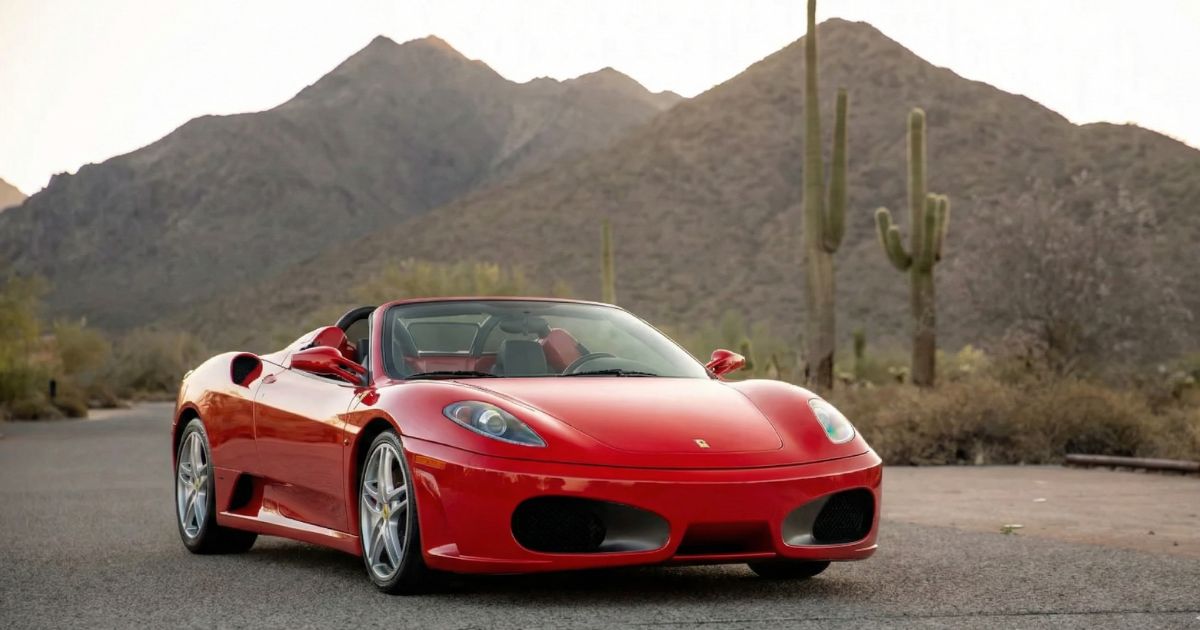
The Ferrari F430 occupies a unique position in the modern Ferrari hierarchy. Produced from 2005 to 2009, it bridged the analog era and the age of digital integration, offering serious performance with genuine driver involvement. For many enthusiasts, it remains the sweet spot of the V8 lineage: the last mid-engine Ferrari you could order from the factory with a gated manual transmission.
If you are seriously considering buying one, here is what you need to know.
What the F430 Actually Is
Internally designated Type F131, the F430 succeeded the 360 Modena and improved on nearly every metric. The Pininfarina bodywork was significantly more aggressive than its predecessor, the front intakes drew inspiration from the 156 Sharknose Formula 1 car, and the rear featured Enzo-style taillights. Beneath the skin, Ferrari used a similar Alcoa aluminum chassis but built around an entirely new engine.
The lineup was straightforward: the Berlinetta coupe and the Spider convertible. In late 2007, Ferrari made carbon-ceramic brakes standard equipment. Buyers should pay attention to production year, 2008 and 2009 cars often include factory refinements to the exhaust system and interior electronics that earlier cars lack.
The F136 V8: A Clean-Sheet Engine
The F430's F136 V8 was a genuine clean-sheet design, departing from the Dino-derived architecture Ferrari had used for five decades. The 4.3-liter unit produces 483 horsepower and 343 lb-ft of torque, and it revs with the kind of urgency that makes the engine one of the car's strongest selling points even today.
Critically, the F430 switched from belt-driven to chain-driven camshafts. This eliminates the expensive three-year timing belt service that made 360 ownership more costly, a meaningful long-term maintenance advantage.
The Failure Points Every Buyer Should Understand
Exhaust headers are the most common mechanical issue on the F430. The factory headers are prone to cracking from heat cycles. A cracked header is more than an annoyance, ceramic material from the pre-catalytic converters can be ingested into the engine if the failure progresses. Look for receipts showing updated OEM headers or quality aftermarket units from suppliers like Fabspeed or Capristo.
Cam variators on some early production cars suffered failures. Confirm that the service history addresses any relevant campaigns or recalls related to this.
Ball joints are known wear items on the F430's suspension and should be treated as consumables rather than surprises. Worn joints produce vague steering and audible clunking, inspect carefully during a PPI.
Active suspension uses Skyhook dampers that are expensive to replace. Check each corner for leaks before committing to a purchase.
Gated Manual vs. F1: The Decision That Defines the Car
This is the most consequential choice in the F430 market, and it is not close.
The 6-speed gated manual represents roughly ten percent of production. These cars command a massive market premium, often $100,000 or more above an equivalent F1 car, and offer a driving experience that no automated system replicates. If a factory manual is what you want, budget accordingly and verify authenticity carefully. Manual conversion companies like EAG do excellent work, but converted cars do not command the same prices as original factory manual examples.
The F1 automated single-clutch system shifts in 150 milliseconds and was genuinely advanced for its time. It requires monitoring of the hydraulic pump, accumulator, and actuator. The accumulator typically has a ten-year lifespan, a car that has not had this addressed is carrying a known upcoming expense. For F1 cars, always request a clutch wear percentage reading from the SD3 diagnostic tool. Clutch replacement runs $5,000–$8,000 and is typically needed between 15,000 and 25,000 miles.
The Electronics: Manettino, E-Diff, and Electrical Gremlins
The F430 pioneered several systems that are now standard across the Ferrari lineup.
The Manettino, the steering wheel dial that adjusts stability control, damping, E-Diff behavior, and shift speed, is robust but depends on the health of various sensors. The E-Diff uses hydraulic pressure to vary the rear differential's locking percentage and is one of the genuinely significant performance innovations of this generation. It requires regular hydraulic fluid flushes to prevent solenoid failure. Look for documentation of this service in the history.
For electrical gremlins broadly: most intermittent issues on F430s trace back to a weak battery. The car is sensitive to voltage drops and should be kept on a battery tender during any period of storage.
Interior: The Sticky Button Problem
The F430 cabin combines high-quality leather and aluminum trim with one persistent defect common across Ferraris of this era: the soft-touch coating on buttons and switches degrades over time into a viscous black residue. It affects virtually every car eventually. Professional refinishing is the only permanent fix, factor this into your evaluation of any car that hasn't had it addressed.
Dashboard leather can also shrink with excessive UV exposure, pulling away from the defroster vents. Check carefully on any car that has lived in a sunny climate without proper protection.
What the Service History Must Show
For any F430, a comprehensive service history is non-negotiable. The chain-driven camshafts eliminate the timing belt service cost, but annual fluid changes remain critical, particularly brake fluid, E-Diff fluid, and gearbox fluid.
The service binder should document:
One counterintuitive reality with F430s: a car that has been driven regularly is often more reliable than a garage queen. Long periods of disuse lead to seized calipers, degraded seals, and contaminated fluids. Low mileage is not automatically a positive on these cars.
Market Values and What Drives Them
The F430 is in a phase of steady appreciation, particularly for specific configurations.
F1 coupes currently trade in the $120,000–$160,000 range. F1 Spiders run $115,000–$155,000. Factory gated manual Berlinettas are in a different market entirely, $250,000 to $350,000 and climbing.
Color matters more on Ferraris than almost any other car. Rosso Corsa over Tan remains the most liquid combination. Rare colors like Tour de France Blue and Grigio Silverstone are increasingly sought by serious collectors and carry a real premium over common configurations.
Carbon-ceramic brake cars (2008 onward standard, earlier cars as an option) carry a slight premium, but inspect rotor wear carefully, as replacement sets cost approximately $10,000.
Frequently Asked Questions
Is the Ferrari F430 reliable compared to other Ferraris of its era?
Relative to its predecessors, yes. The switch to a timing chain removes the most expensive scheduled service from ownership. The F430 is not a low-maintenance car by any standard, but owners who drive regularly and follow the annual fluid service schedule find it more approachable than its reputation suggests.
What is the most important thing to check when buying an F430?
The exhaust headers and, for F1 cars, the clutch wear percentage. These are the two items most likely to represent significant near-term expense on a car without documented maintenance history.
Should I buy an F430 with a manual conversion or hold out for an original factory manual?
If budget allows, hold out for a factory manual. The driving experience is equivalent, but the market treats them very differently, and that gap has been widening, not narrowing. If a conversion is the only option within your budget, ensure it was performed by a reputable specialist and documented thoroughly.