Jan 13, 2026
Alan Jones: The Gritty 1980 F1 Champion Who Built the Williams Dynasty
Alan Jones didn't just win the 1980 F1 title, he built the Williams dynasty. Explore the raw grit, the FW07, and the rivalry that defined a legend.
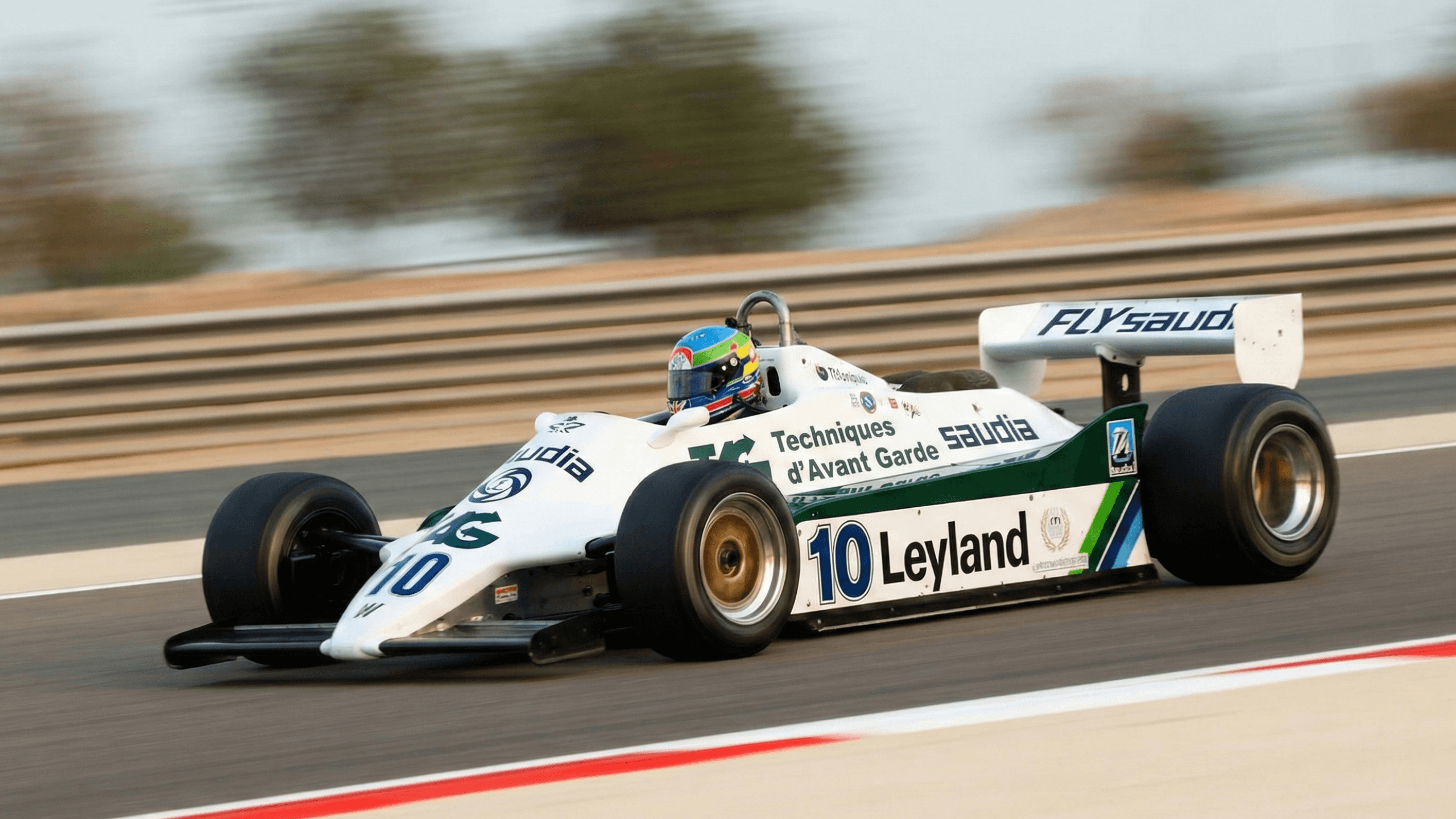
Alan Jones didn’t just drive for Williams, he ushered in the future. In an era defined by the smoothness of Alain Prost or the risk of Nelson Piquet, Jones was different. He was a man who preferred a wrench to a wine glass and a fistfight to a boardroom meeting.
To understand the 1980 World Champion is to understand the DNA of Williams Grand Prix Engineering. Before Jones, Frank Williams was a struggling dreamer operating out of an old carpet warehouse. After Jones, Williams was a juggernaut. This wasn't a partnership of convenience, it was a merging of three minds, Frank Williams, Patrick Head, and Alan Jones, that produced the most no-nonsense championship in the history of the sport.
The Grind: Buying a Career One Van at a Time
Most modern F1 drivers arrive via a conveyor belt of karting titles and family millions. Alan Jones arrived via a used car lot. When he landed in London in the late 1960s, he didn't have a manager or a simulator contract, he had a roommate named Brian McGuire and a side hustle flipping camper vans to fellow Australians.
His debut in 1975 with Harry Stiller’s Hesketh and a brief stint with Graham Hill’s team were mere appetizers. The real breakthrough came in 1977 at a rain-soaked Österreichring. Driving for Shadow, a team reeling from the death of Tom Pryce, Jones ignored the script and powered to a maiden win. It was a performance of such raw grit that it forced Frank Williams to realize that if he wanted to win, he needed the Aussie.
The Williams FW07
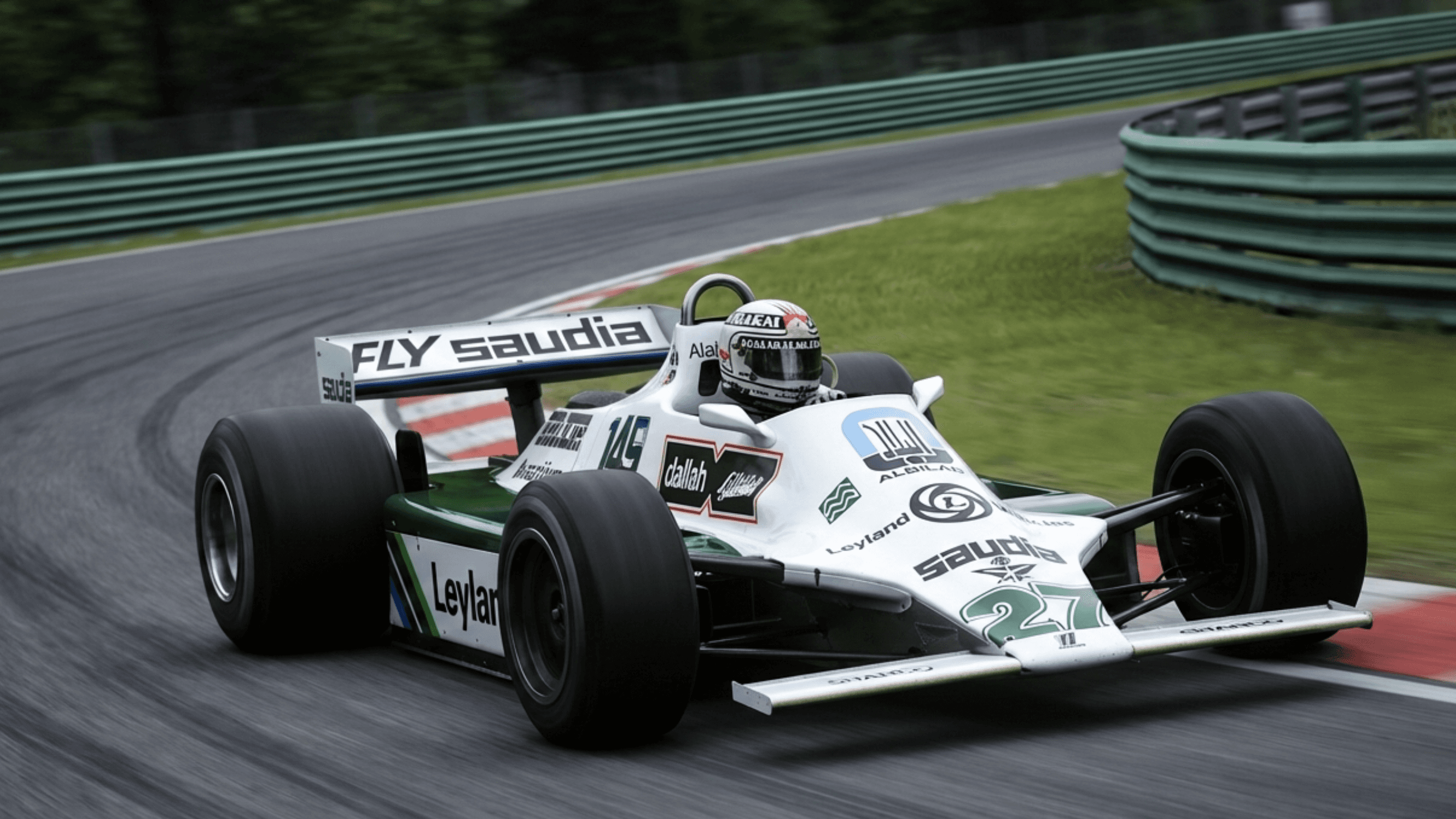
In 1978, the alliance was formed. Frank provided the platform, Patrick Head provided the steel, and Jones provided the violence. The early FW06 was a promising start, but 1979 changed the sport. Head’s FW07 was a ground-effect masterpiece, a car that didn't just move through the air but pinned itself to the earth with the force of a falling building.
Jones and the FW07 were a symbiotic pair. The car required immense physical strength to manage the mounting G-loads of ground-effect aerodynamics, and Jones was built like a middleweight boxer. He won four of the last six races in ’79, signaling to the paddock that the 1980 season was already over before it began.
1980: The Season of Pure Dominance
The 1980 title race was a demolition job. Jones didn't just beat Nelson Piquet; he broke the opposition's will. Driving the FW07B, Jones was the paragon of consistency and aggression.
The 1980 Statistical Snapshot:
Wins: 5 (Argentina, France, Britain, Canada, USA)
Podiums: 10
Points: 67 (effectively 71 before drops)
Status: First-ever Champion for Williams.
That year, he returned home to win the Australian Grand Prix at Calder Park. He didn't just win, he lapped the entire field. It remains one of the most arrogant displays of superiority in the history of the event, a World Champion returning to his backyard to show the locals exactly how far the gap really was.
The Reutemann War: A Championship Lost to Spite
The 1981 season should have been a coronation. Instead, it was a civil war. Williams signed Carlos Reutemann, an elegant, moody Argentinian who was the polar opposite of the beer-drinking, plain-speaking Jones.
The fuse was lit at the Brazilian Grand Prix. In a torrential downpour, Reutemann ignored a pit board that read "JONES-REUT", an explicit order to let the champion through. Reutemann took the win. Jones was apoplectic. The team was fractured.
The climax at the 1981 Caesars Palace Grand Prix in Las Vegas is the stuff of legend. Piquet was the title rival, but Jones’s focus was entirely on ensuring Reutemann failed. Jones disappeared into the distance to win the race, refusing to lift an inch to help his teammate. Reutemann faded to eighth, losing the title by a single point. Jones’s grin on the podium wasn't for the trophy; it was for the empty hands of the man in the other garage.
The "Fed Up" Retirement and the Final Act
Jones’s retirement at the end of 1981 wasn't a tragedy, it was a lifestyle choice. He was, in his own words, "fed up with England." He hated the cold testing days at Donington and the pretension of the European paddock. He wanted his farm in Australia and a life away from the circus.
His later returns with Arrows (1983) and the Haas Lola (1985-86) are often dismissed as failed footnotes, but they underscored a fundamental truth: Jones was only as good as his environment. Without the iron triangle of Williams and Head, the magic was gone. He was a driver who needed a car as tough as his personality.
The Legacy: The Measuring Stick for Williams
Alan Jones didn't just win a championship, he set the cultural benchmark for every driver who followed him at Williams. From Keke Rosberg to Nigel Mansell, the Williams driver was defined by the Jones template: aggressive, technically astute, and utterly devoid of ego-driven theatrics.
He remains the last Australian to win the Australian Grand Prix and the man who turned a carpet warehouse operation into a global empire. Alan Jones wasn't just a racer; he was the foundation.