Jan 13, 2026
The Wild Man of Maranello: Why Jody Scheckter is F1’s Most Underrated Icon
Jody Scheckter is the only South African Formula 1 World Champion and a legendary figure in Ferrari’s history. Originally dubbed the "South African Wild Man" for his aggressive early career, Scheckter famously matured into a master tactician.
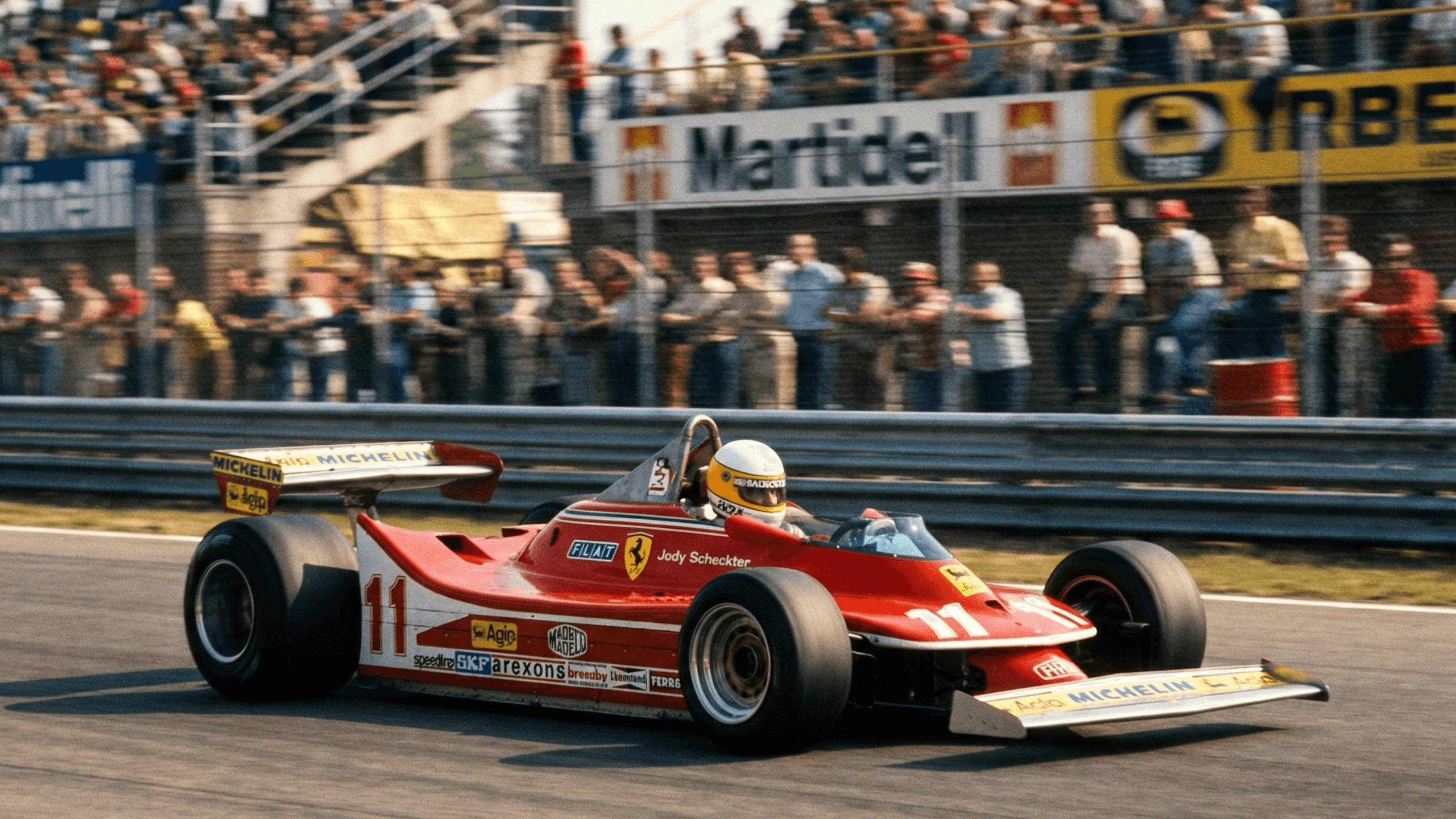
The story of Jody Scheckter does not begin with a trophy, it begins with a black flag. Born in January 1950 in East London, South Africa, Scheckter was raised in the grease and grit of his father’s Renault dealership. By the time he transitioned from motorcycles to saloon cars, his reputation preceded him. He was fast, yes, but he was also terrifyingly erratic. In his very first national race, he was black-flagged for reckless driving, a prelude to the "Wild Man" persona that would soon polarize the Formula One paddock.
Scheckter’s raw talent was undeniable, and at age 20, he won the South African Formula Ford Series. This victory secured him the Driver to Europe scholarship, a flight to the United Kingdom, and a seat in the international spotlight. In the rain-slicked circuits of England, he climbed through Formula 3 with a style that can only be described as chaotic brilliance. He was a man who spun as often as he won, yet he possessed a car control that seemed to defy the laws of physics.
His entrance into Formula One with McLaren in 1972 was an immediate shock to the system. By 1973, he was a permanent fixture on the grid and a permanent source of anxiety for his peers. At the French Grand Prix, Scheckter collided with reigning World Champion Emerson Fittipaldi, prompting the Brazilian to famously declare that the South African was a "menace to himself and everybody else." The tension reached a breaking point at Silverstone that same year. In a moment that remains etched in F1 history, Scheckter lost control at Woodcote Corner, triggering a massive pile-up that destroyed eight cars and ended the career of Andrea de Adamich. The Grand Prix Drivers Association demanded his expulsion, and McLaren was forced to rest their young charger for four races.
However, the Wild Man died later that year, replaced by a much more formidable version of Scheckter. While practicing at Watkins Glen, he witnessed the horrific fatal crash of his future teammate, François Cevert. Being the first on the scene of such a tragedy acted as an involuntary but powerful catalyst. Scheckter realized that raw aggression was a dead end. He pivoted, becoming a disciplined, safety-conscious tactician. When Ken Tyrrell offered him a full-time drive in 1974, Scheckter rewarded him with a third-place finish in the championship and his first Grand Prix wins. By 1975, he had become a national hero, winning the South African Grand Prix at Kyalami, the first and only South African to do so.
This era also saw Scheckter pilot the most radical experiment in motorsport history: the six-wheeled Tyrrell P34. While he famously called the car a "piece of junk" due to its complex steering and the struggle to find consistent 10-inch tires from Goodyear, his professional adaptability allowed him to win the 1976 Swedish Grand Prix in it. To this day, he remains the only driver to ever win an F1 race in a vehicle with more than four wheels.
After a successful stint with the underdog Walter Wolf Racing team, where he finished second in the 1977 championship, Scheckter made the move that would define his legacy: he joined Ferrari. Teaming up with the legendary Gilles Villeneuve, Scheckter defied the toxic reputation of Maranello. The two formed a partnership based on open communication and mutual respect, sharing setup data that propelled the Ferrari 312 T4 to the front of the grid. While Villeneuve provided the spectacular speed, Scheckter provided the championship-winning consistency. At the 1979 Italian Grand Prix at Monza, Scheckter led Villeneuve home in a 1-2 finish to secure the World Championship. It would be Ferrari’s last Drivers' title until Michael Schumacher arrived two decades later.
Scheckter’s exit from the sport was as pragmatic as his driving. After a dismal 1980 season in an uncompetitive car, he retired at age 30, having reached the summit. But his competitive drive simply found a new outlet. He moved into the tech sector, founding Firearms Training Systems (FATS), a weapons simulation business that he eventually built into a $100 million empire. When he sold that business, he didn't head for a yacht, he headed for a farm. Today, Scheckter is a world-renowned expert in biodynamic and organic farming at Laverstoke Park Farm, applying the same precision to soil health that he once applied to the apexes of Kyalami.
Jody Scheckter remains a mystifying figure, a man who transformed from a reckless teenager into a calculating champion, and finally into a visionary entrepreneur. He is more than just Africa’s only F1 champion, he is a testament to the power of personal evolution.