Jan 13, 2026
The Speed of Fear: The Brutal Rise and Fatal Fall of Group B
Group B Rally: The Golden Age of Fear. Explore the 500hp, twin-charged monsters and the unhinged era that pushed human reflexes to the fatal limit.
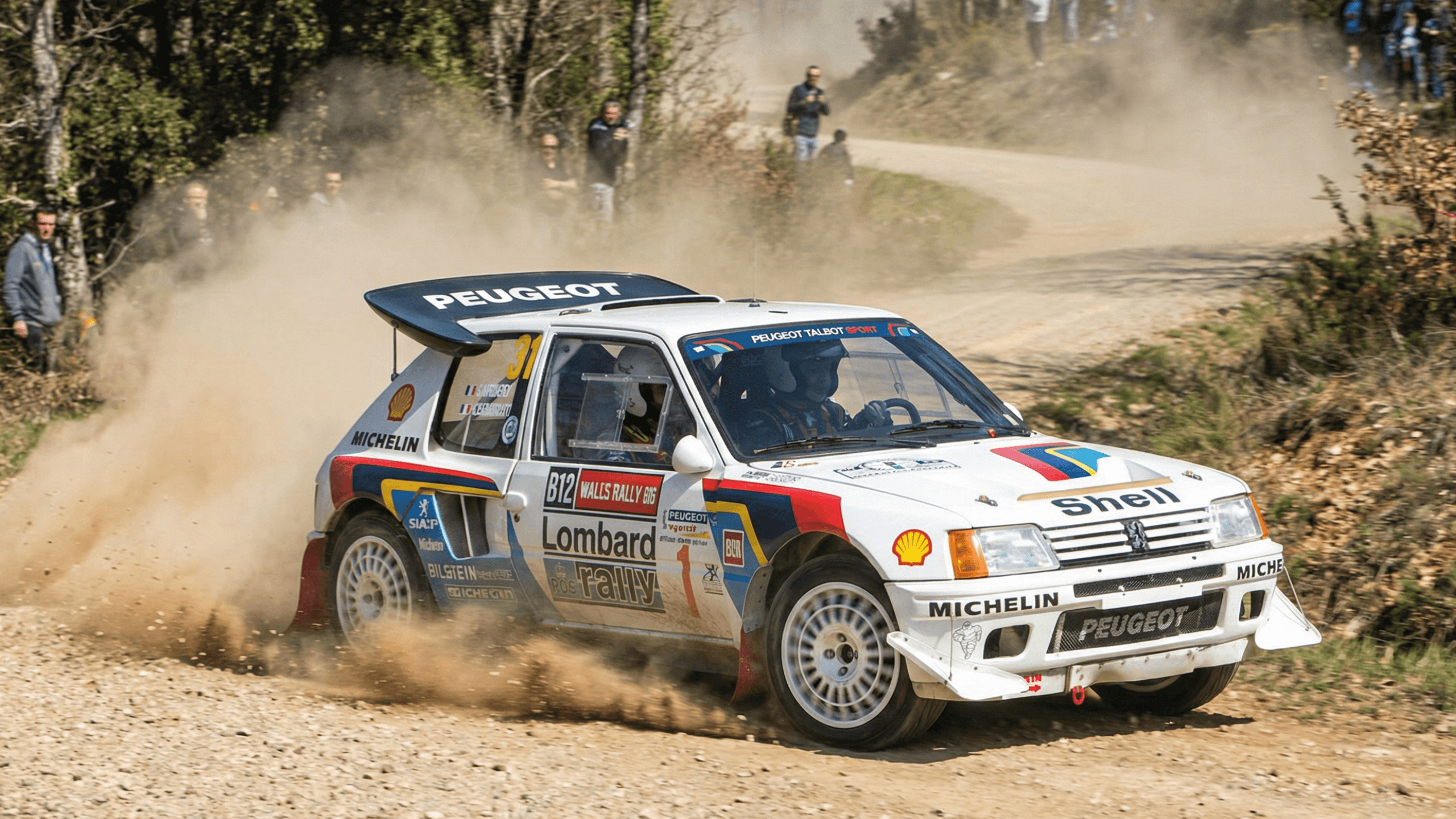
In the quiet forests of Finland and the sun-baked hills of Corsica, there was a sound that redefined the limits of mechanical endurance. It was a guttural, five-cylinder howl punctuated by the chirps of a wastegate, a sound that signaled the approach of a machine moving too fast for the human eye to track. From 1982 to 1986, the World Rally Championship entered the Group B era, a four-year fever dream where engineering ambition was decoupled from safety, resulting in cars that remain the most visceral weapons to ever touch gravel.
The Blueprint of a Beast
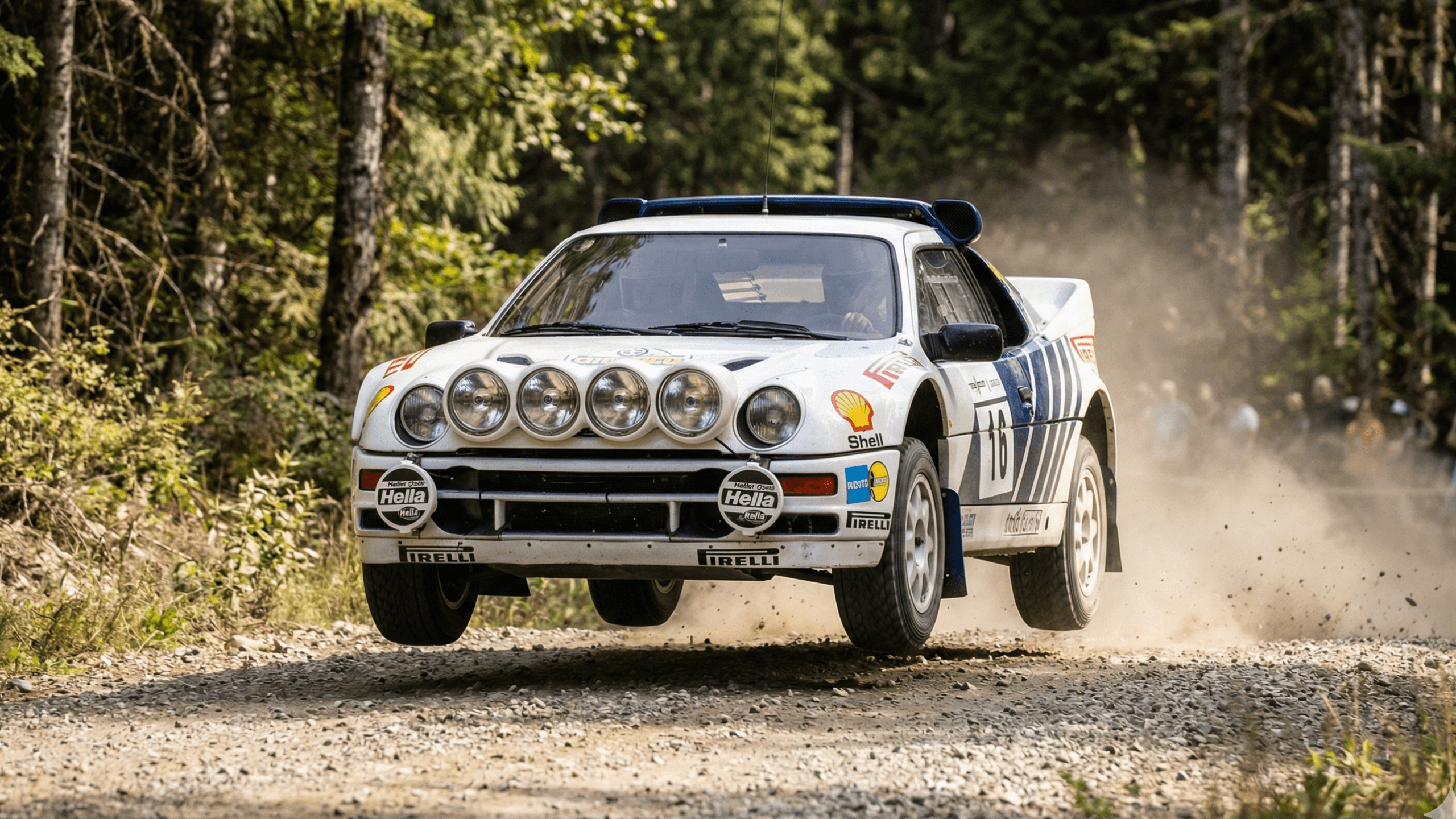
The origin of Group B was a 1982 FISA rulebook that essentially offered manufacturers a blank canvas. By slashing the homologation requirement from 400 units to just 200, the FIA allowed homologation specials, purpose-built monsters like the Ford RS200 and the Peugeot 205 T16, to exist. These were not modified road cars, they were space-frame prototypes draped in thin fiberglass and Kevlar, designed solely to win.
The regulations lacked a ceiling for turbo boost, creating a vacuum that engineers filled with terrifying amounts of power. In 1981, top-tier rally cars produced roughly 250 horsepower. By 1986, Audi’s Sport Quattro S1 E2 was officially claiming 473 hp, though internal estimates and dynamometer runs suggested figures north of 550 hp. This was light-switch power, delivered via massive KKK turbochargers that suffered from agonizing lag followed by a violent, unmanageable surge of torque.
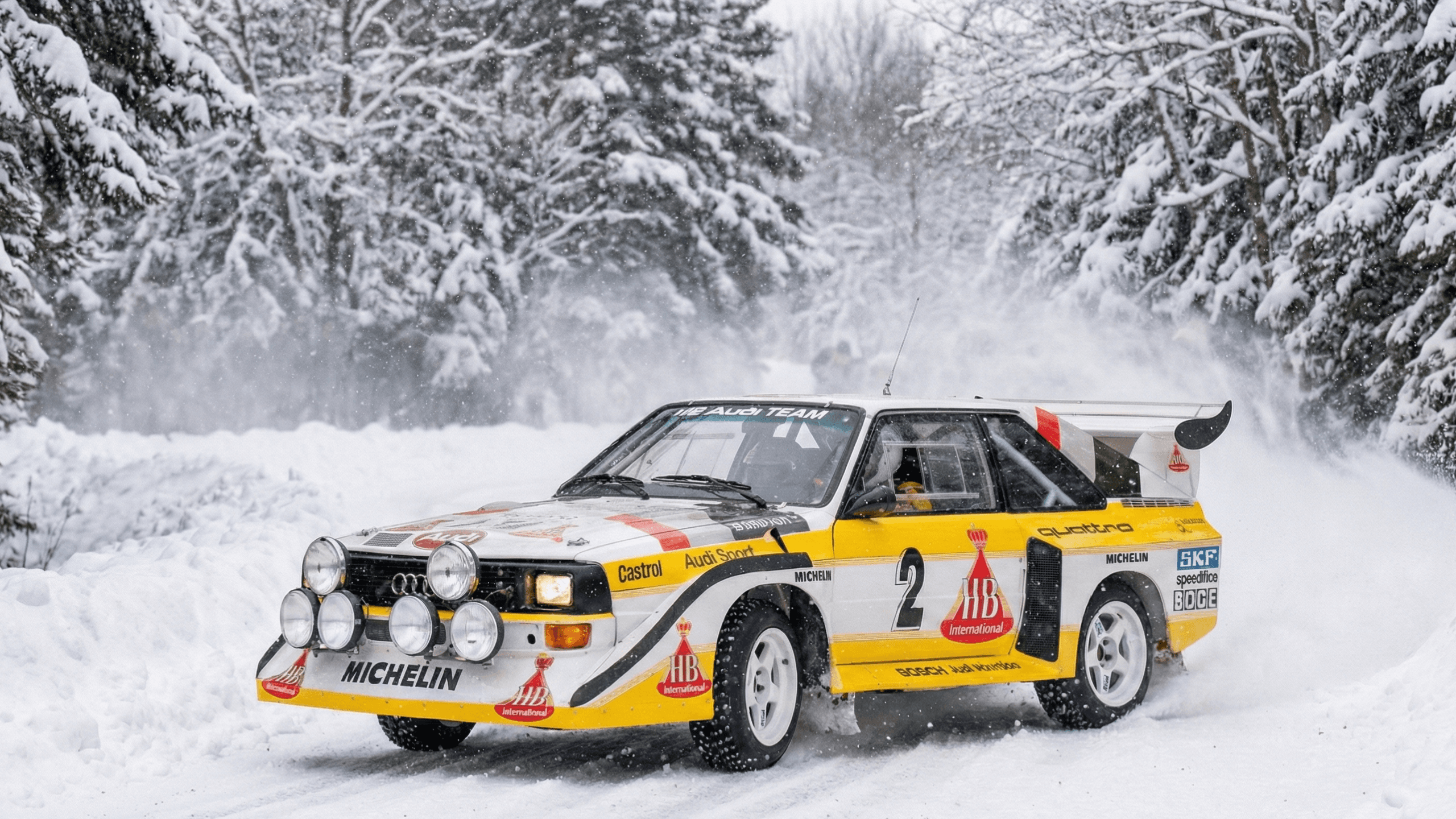
Lancia’s solution to this lag was the Delta S4’s twin-charging system. By mounting a Volumex supercharger for low-end grunt and a massive K27 turbocharger for high-end boost, they created a 1,759cc four-cylinder engine that could theoretically hit 1,000 hp under extreme test conditions. In rally trim, it produced a reliable 550 hp, propelling the 890 kg car from 0 to 60 mph on loose gravel in just 2.5 seconds.
The Gods and Their Chariots
Taming these machines required more than skill, it required a cognitive recalibration. Drivers like Walter Röhrl, Stig Blomqvist, and Michèle Mouton were operating at the absolute edge of human reaction times. Röhrl famously described the experience not as driving, but as trying to keep up with the car’s thoughts. The Sport Quattro S1 E2, with its radical aerodynamics and massive front wings, was an attempt to keep the car on the ground, yet it remained a "hand-grenade" on wheels, prone to understeer and sudden, terminal bursts of speed.
The tragedy of the era was centered on Henri Toivonen, the young prodigy who symbolized the peak and the end of Group B. During the 1986 season, Toivonen reportedly took his Lancia Delta S4 to the Estoril F1 circuit in Portugal and recorded a lap time that would have qualified him in the top ten for that year’s Formula One Grand Prix. Whether the legend is perfectly accurate or slightly embellished by time, the message was clear: rally cars had caught up to F1, but they were doing it on narrow mountain passes lined with spectators.
The Inevitable Tragedy
Group B didn't fail because of the cars alone, it failed because the world wasn't ready for them. Spectator control was non-existent. Fans would stand in the middle of the road, parting only at the last millisecond as a car thundered through at 120 mph. The Rally de Portugal in March 1986 saw Joaquim Santos lose control of his Ford RS200 while swerving to avoid fans, killing three and injuring dozens.
The final blow landed on May 2, 1986, at the Tour de Corse. Henri Toivonen and co-driver Sergio Cresto were leading the rally when their Lancia plunged into a ravine. The aluminum fuel tanks, unprotected by the car’s space-frame, ruptured. The magnesium wheels caught fire. By the time rescuers arrived, there was nothing left but a charred skeleton of a chassis. Within hours, FISA President Jean-Marie Balestre announced the ban. Group B was over.
A Ghost in the Machine
The legacy of Group B is not one of failure, but of a necessary, violent evolution. The era proved that all-wheel drive, mid-engine layouts, and composite materials were the future. When Group A took over in 1987, the cars were slower, safer, and based on mass-produced models like the Lancia Delta Integrale. Yet, within a few years, advances in suspension, tire technology, and electronics allowed Group A cars to beat the stage times of their Group B predecessors.
Today’s Rally1 hybrids are faster, more efficient, and infinitely safer, but they lack the untamed, frightening soul of the 1980s. Group B remains a cautionary tale of what happens when ambition outstrips responsibility, a brief, glorious, and bloody moment when humans tried to outrun their own reflexes.